

Continuity Tester vs. Blasting Ohmmeter: What’s the Difference?
Posted by Ideal Blasting on Aug 21st 2026
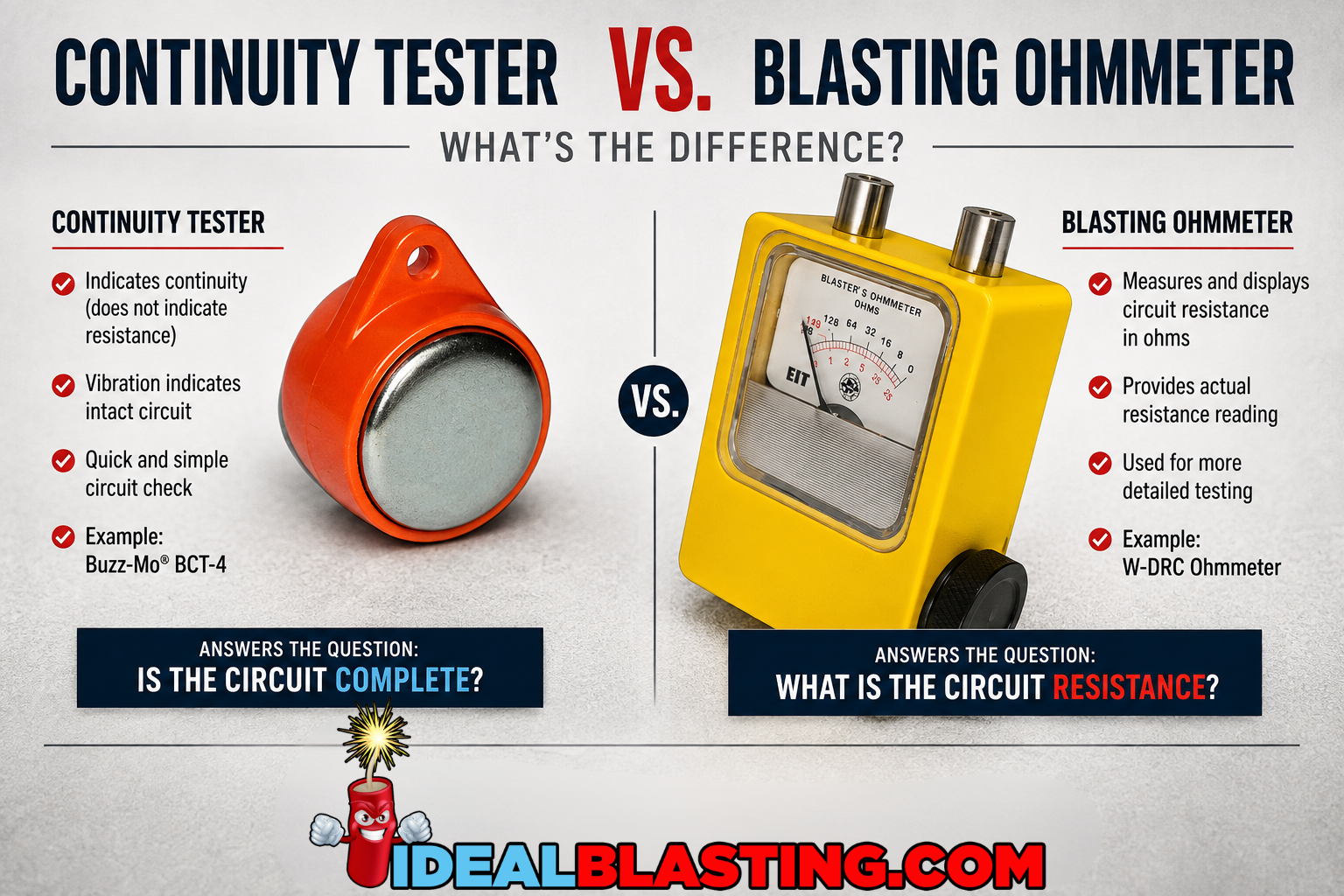
Continuity Tester vs. Blasting Ohmmeter: What’s the Difference?
Electrical testing equipment is an important part of a blaster's tool kit, but not every tester provides the same information. Two common tools—continuity testers and blasting ohmmeters—serve related but distinctly different purposes.
A continuity tester answers a basic question: Is the circuit complete? A blasting ohmmeter goes further by providing a resistance measurement.
Understanding that distinction can help when selecting testing equipment for a particular application.
What Does a Continuity Tester Do?
A continuity tester is designed to provide a quick indication of whether an electrical circuit is intact.
Rather than displaying a resistance value, the tester provides a simple indication that continuity is present—or that an open circuit has been detected.
This makes a continuity tester useful when the primary objective is straightforward circuit verification rather than obtaining a resistance measurement.
An Example: The Buzz-Mo Continuity Tester
The Buzz-Mo BCT-4 Bridgewire Continuity Tester provides a good example of this type of instrument.
Instead of relying on a visual display, the Buzz-Mo uses a strong vibration to indicate an intact bridgewire circuit. This haptic indication can be particularly useful in bright sunlight or noisy working environments where an LED or audible indication may be less convenient.
The manufacturer specifically notes that the vibration indicates an intact bridgewire circuit—it does not indicate resistance.
The Buzz-Mo is also designed with a maximum current draw of less than 60 µA and incorporates a 50 mA fuse in the testing circuit.
Ideal Blasting currently offers the Buzz-Mo in both black and safety-orange configurations.
What Does a Blasting Ohmmeter Do?
A blasting ohmmeter provides more information.
Instead of simply confirming that a circuit exists, an ohmmeter measures and displays the electrical resistance of the circuit in ohms.
This allows a qualified user to obtain an actual resistance reading rather than a simple continuity/no-continuity indication.
Blasting ohmmeters are specifically designed for use in blasting applications. They should not be confused with ordinary electrical meters simply because both may be capable of measuring resistance.
Example: Ideal Blasting W-DRC Galvanometer
The Ideal Blasting W-DRC Analog Blaster's Ohmmeter measures and displays the resistance of an attached blasting circuit in ohms.
The W-DRC is MSHA approved and uses a 0.9-volt silver chloride battery. Its housing is waterproof and designed to float, while also providing resistance to dust, gasoline, oil, sand, impact and other conditions encountered in field use.
The unit measures resistance only and is specifically marked not to be used for measuring voltage or current.
At approximately 3 × 1.5 × 4 inches and 10 ounces, it is also designed as a compact field instrument.
Another Option: Model 106 MSHA Ohmmeter
For users who prefer a digital display, the Model 106 MSHA Ohmmeter provides another approach.
This compact meter is MSHA approved and features a backlit LCD for improved visibility in low-light conditions. Its measurement range is 1 ohm to 2,000 ohms, with a specified current output of less than 4 mA.
The Model 106 weighs approximately five ounces and comes with a Cordura® protective case.
These differences illustrate why choosing a tester involves more than simply deciding between "analog" and "digital." The first question should be what information the user actually needs from the instrument.
Continuity Tester vs. Ohmmeter at a Glance
| Continuity Tester | Blasting Ohmmeter | |
|---|---|---|
| Primary purpose | Determine whether continuity is present | Measure circuit resistance |
| Result | Continuity/open-circuit indication | Resistance reading in ohms |
| Resistance value provided | No | Yes |
| Example | Buzz-Mo BCT-4 | W-DRC, Model 106 |
| Best suited for | Quick continuity verification | Applications requiring an actual resistance measurement |
Neither category should automatically be considered "better." They provide different information.
What Should You Consider When Choosing a Tester?
Start with the intended application and the information that needs to be obtained.
Do You Only Need to Confirm Continuity?
If the objective is simply determining whether a circuit is intact, a dedicated continuity tester may provide everything required without the additional features of a resistance-measuring instrument.
Do You Need an Actual Resistance Reading?
When an application requires knowing circuit resistance, a continuity-only tester isn't sufficient. A blasting ohmmeter or appropriate blasting multimeter provides the additional measurement capability.
What Type of Indication Works Best?
Testing equipment is available with different methods of communicating results.
Depending on the instrument, this can include:
-
Haptic or vibration indication
-
Analog meter displays
-
Digital displays
-
Backlit digital displays
Working environment, visibility and user preference can all factor into the decision.
Is the Instrument Designed for the Intended Application?
Electrical meters are not automatically interchangeable.
Equipment used for blasting-related circuit testing should be selected according to its intended use, applicable manufacturer instructions, specifications and organizational procedures.
This is also why using an ordinary general-purpose multimeter simply because it can measure resistance should not be assumed to be equivalent to using an instrument specifically designed for blasting applications.
Beyond Continuity Testers and Ohmmeters
Some applications require more capabilities than either a basic continuity tester or a dedicated ohmmeter provides.
Ideal Blasting's testing-equipment selection also includes blasting multimeters, as well as specialized meters and accessories for more comprehensive electrical testing requirements.
Choosing among these instruments comes down to identifying what needs to be measured—not simply buying the tester with the greatest number of functions.
Choosing the Right Blasting Testing Equipment
For many users, the distinction can be summarized simply:
Need to know whether the circuit is complete? Consider a continuity tester.
Need to know the circuit's resistance? Consider a blasting ohmmeter.
Need additional electrical measurements? A blasting multimeter may be the more appropriate category to evaluate.
Actual equipment selection should always take into account the intended application, manufacturer instructions, applicable regulations and established operating procedures.
Ideal Blasting Supply carries a range of continuity testers, blasting ohmmeters, galvanometers and blasting multimeters for professional blasting applications.
If you're unsure which type of testing equipment fits your requirements, contact Ideal Blasting Supply for assistance comparing available options.