
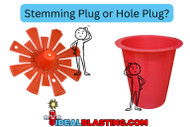
Stemming Plugs or Hole Plugs: What’s the Difference?
Posted by Ideal Blasting on Aug 28th 2026
One of the most common sources of confusion when ordering drill-hole products is the difference between a stemming plug and a hole plug.
Although both products are called “plugs,” they perform different functions and are installed in different locations. A stemming plug is placed inside the borehole and becomes part of the internal blasting setup. A hole plug is placed at the top of the hole and is primarily used to protect, identify and temporarily cover the opening.
What Is a Stemming Plug?
A stemming plug, sometimes called a spider plug, is designed to be positioned down inside the borehole.
Its primary function is to separate or contain materials within the hole during a drilling and blasting operation. Depending on the application, a stemming plug may be placed at a specific depth to help support stemming material, separate explosive products from other materials or create a defined internal arrangement within the borehole.
Stemming plugs are generally flexible and are designed to fit securely against the inside walls of the borehole. Their shape allows them to accommodate a range of hole diameters while remaining positioned at the desired depth.
Ideal Blasting carries several types and sizes of stemming products for professional drilling and blasting applications.
Spider Stemming Plugs
The familiar Spider Stem Plug gets its nickname from its flexible, spider-like design. The plug has extending legs or flexible contact points that press against the borehole walls. These features help hold the plug in position inside the hole rather than allowing it to slide freely.
It is designed to be installed below the surface, where it can help maintain separation between materials and support the intended internal layout of the borehole.
Ideal Blasting currently offers several sizes, including:
-
Mini Stem Plug – Red – for 3-1/2" to 4-1/2" hole sizes
-
8" Spider Stem Plug – White – for 4-1/2" to 6" hole sizes
-
13" Spider Stem Plug – White – for 6" to 7-7/8" hole sizes
The correct size is important because the plug must be compatible with the hole diameter. A plug that is too small may not remain securely positioned, while a plug that is too large may be difficult or impossible to install properly.
Ideal Blasting also offers a Stem Plug Guide for the 8" and 13" Spider Stem Plugs. The guide can help users understand the intended placement and installation of these larger stemming plugs.
What Is a Hole Plug?
A hole plug, sometimes called a drill hole plug or blast hole plug, serves a very different purpose.
Rather than being positioned down inside the borehole, a hole plug is placed at the top of the drilled hole, usually at or near the collar. Its main function is to cover and identify the opening while the hole is waiting to be loaded, inspected or otherwise used.
Hole plugs are commonly used to help:
-
Keep dirt, rock and other material from backfilling a drilled hole
-
Make drilled holes easier to identify
-
Protect the opening while work progresses
-
Reduce the chance that tools, loose material or debris will fall into the hole
-
Maintain an organized drilling pattern
-
Provide a visible indication that a hole has already been drilled or is being reserved for a later operation
A hole plug does not perform the same internal function as a stemming plug. It generally does not extend down into the borehole or become part of the internal arrangement of the hole. Instead, it acts as a surface-level cover and marker.
Think of a hole plug primarily as a borehole protector and marker at the surface rather than an internal stemming component.
Ideal Blasting’s traditional plastic hole plugs are lightweight, stackable and designed for easy insertion and removal. Their bright colors also make them easier to see in active work areas, which can help crews identify drilled holes and maintain an organized pattern.
The Simplest Way to Remember the Difference
The easiest distinction is:
STEMMING PLUG = goes DOWN into the hole
HOLE PLUG = sits ON TOP of the hole
The difference is based on both placement and function. A stemming plug is installed inside the borehole to support the internal setup. A hole plug remains at the surface to cover, protect and identify the opening.
Although both products are called “plugs” and both are associated with drilled holes, they are not interchangeable.
Color Does Not Define the Plug Type
Color can help identify a particular product once you already know what type of plug you are looking for, but it is not a reliable way to determine whether you need a stemming plug or a hole plug.
Most traditional hole plugs are red, but Ideal Blasting also carries a red Mini Stem Plug. Other stemming plugs, including the larger Spider Stem Plugs, are white. Depending on the product, hole plugs may also be available in red, orange, green or blue.
For example:
| Product | Where It Goes | Primary Function | Example Color |
|---|---|---|---|
| Mini Stem Plug | Down inside the hole | Internal stemming and borehole separation | Red |
| 8" Spider Stem Plug | Down inside the hole | Internal stemming and support at larger hole sizes | White |
| 13" Spider Stem Plug | Down inside the hole | Internal stemming and support at larger hole sizes | White |
| Traditional Hole Plug | Top of the hole | Covers, protects and identifies the hole opening | Most commonly red |
| Other Hole Plug Configurations | Top of the hole | Surface protection, visibility and identification | Red, orange, green or blue |
The most useful way to identify the correct product is to determine where it goes and what it is designed to do.
Hole Size Matters Too
Once you have established whether you need a stemming plug or a hole plug, the next important piece of information is the hole diameter.
Hole diameter determines whether the plug can be inserted properly and whether it will perform as intended. A plug designed for a small surface hole is not interchangeable with a stemming plug designed for a much larger borehole.
Both product families are available in different sizes.
For example, compare two products that are both red:
Red Mini Stem Plug: 3-1/2" to 4-1/2" holes
Red #1 Hole Plug: 3/4" to 1-3/4" holes
Despite both being red and both being called “plugs,” they are clearly very different products.
The Red Mini Stem Plug is larger and is designed to be placed down inside a 3-1/2" to 4-1/2" borehole. The Red #1 Hole Plug is designed for a much smaller hole and sits at the surface to cover and identify the opening.
Knowing the hole diameter and where the plug is supposed to go makes identifying the correct product much easier.
Stemming Plug or Hole Plug? Start With Where It Goes
The terminology is similar, and even the colors can overlap, but the fundamental difference is straightforward:
Stemming plugs go down inside the borehole.
They are internal components used to help organize, separate or support materials within the hole.
Hole plugs sit at the top of the borehole.
They are surface-level products used to cover, protect and identify the opening.
Ideal Blasting Supply carries a broad selection of Stemming Plugs & Bags as well as Drill Hole Plugs in multiple sizes and configurations.
The key distinction is simple: a stemming plug goes inside the hole, while a hole plug sits on top of it.