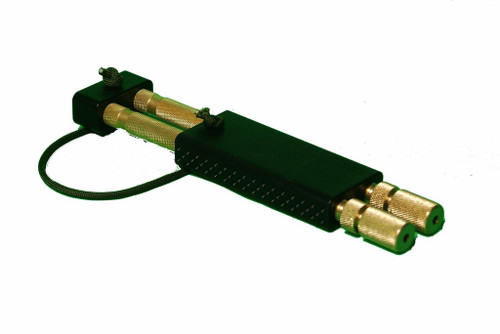
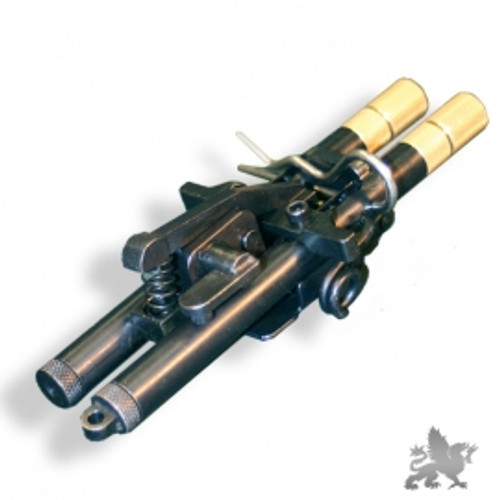
The BlasterOne DCIR is a high-speed, robot-mounted dual-channel initiator designed specifically for Bomb Squad and EOD robotic platforms. The DCIR uses the robot's selectable power outputs for operator-controlled initiation and is not a wireless firing device.
Two independent firing circuits provide initiation capability for up to two channels. The DCIR initiates shock tube within 800 milliseconds of power-up, allowing rapid operation of shock-tube-powered devices. An integrated Picatinny Rail clamp provides quick mounting to the robotic platform, while retractile power cords connect the DCIR directly to the robot's power ports.
The DCIR is available in two factory-specified firing configurations: two-channel Nonel/shock tube, or one Nonel/shock-tube channel combined with one electrical/electric breech channel. This configuration is not changeable in the field and must be specified when the DCIR is ordered.
The DCIR must be ordered in one of two firing configurations:
The firing configuration is not field-changeable and must be specified at the time of order.
| Channels | 2 Independent Firing Channels |
| Configuration 1 | (2) Nonel / Shock-Tube Channels |
| Configuration 2 | (1) Nonel / Shock-Tube Channel + (1) Electrical/Electric Breech Channel |
| Field Configurable | No – Firing Configuration Must Be Specified at Time of Order |
| Shock-Tube Capacity | Single-Prime or 3 mm Shock Tube Per Channel, Configuration Dependent |
| Shock-Tube Ignition | Replaceable Plasma Emitters – Up to 50 Shots Each |
| EBC Firing Energy | 385 VDC @ ~11 Joules |
| Electrical Firing Capacity – US Standard | 81 |
| Electrical Firing Capacity – US Coal/Oil | 69 |
| Electrical Firing Capacity – US Seismic | 43 |
| Electrical Firing Capacity – EU Class 1 | 81 |
| Electrical Firing Capacity – EU Class 2 | 69 |
| Electrical Firing Capacity – EU Class 3 | 43 |
| Electrical Firing Capacity – EU Class 4 | 7 |
| Electrical Breech | Safety Fuse in Electrical Breech; Voltage Releases in <250 ms |
Electrical firing capacity results may vary depending on detonators, wire, and other factors. Parallel firing is not recommended.
The DCIR is not a wireless device. Power and firing control are provided by the host robot. The DCIR relies on the robot having one or two 18–24 VDC @ 3A power ports that can be selected and activated from the robot's controller.
For independent operation of both DCIR channels, the robot requires two compatible, independently selectable power ports. If the robot has only one compatible power port, only one DCIR channel can be used at a time. The operator can still choose which of the two DCIR channels is connected to the available robot power port.
| Wireless | No |
| Power Source | Host Robotic Platform |
| Required Input | 18–24 VDC @ 3A |
| Power Polarity | Non-Polarized |
| Two-Channel Operation | Requires (2) Compatible, Independently Selectable Robot Power Ports |
| Single-Port Robot | One Channel Can Be Used at a Time; Operator Selects Which DCIR Channel to Connect |
| Control | Activation Through the Robot's Controller |
| Minimum Activation Time | Robot Must Maintain Power for a Minimum of 1 Second |
| Temperature Range | -13°F to 158°F (-25°C to 70°C) |
| Overall Height | 5.9 in. (15 cm) |
| Body Dimensions | 2.4 in. W × 5.9 in. L × 1.8 in. Thick (6.1 × 15 × 4.5 cm) |
| Maximum Width | 2.9 in. |
| Maximum Thickness | 2.2 in. |
| Weight | 23 oz. with Retractile Power Cords |
| Material | Aluminum and Glass-Filled Nylon |
| Ingress Protection | IP65 Compliant – Resistant to Water Jets |
| Mounting | Picatinny Clamp |
The BlasterOne DCIR is backed by a Lifetime Warranty Against Manufacturing Defects.
The required firing configuration must be specified when ordering. Choose either the two-channel Nonel/shock-tube configuration or the combined one-channel Nonel/shock-tube and one-channel electrical/electric breech configuration. The firing configuration cannot be changed in the field.
Robot compatibility should also be confirmed before ordering. Two independently selectable 18–24 VDC @ 3A robot power ports are required to operate both DCIR channels independently. A robot with one compatible power port can operate one DCIR channel at a time.